Bulk material conveying systems play a central role in industrial production, connecting storage, processing, weighing, and discharge operations into a continuous material flow. In industries such as metallurgy, mining, cement, power generation, and chemical processing, efficient conveying solutions help maintain production stability, improve material transfer accuracy, and reduce unnecessary handling. Selecting the right conveying equipment requires a clear understanding of material characteristics, operating conditions, layout requirements, and production capacity.
The Role of Bulk Material Conveying in Industrial Processing
Bulk material conveying is more than moving raw materials from one location to another. It directly affects the coordination of upstream and downstream equipment, production continuity, plant utilization, and overall process efficiency. A well-designed conveying system ensures that materials arrive at the required destination at a controlled rate, supporting stable operation across multiple production stages.
In metallurgical plants, bulk materials such as ores, sinter, coke, limestone, and other raw materials must be transported reliably between storage facilities, preparation systems, furnaces, and processing units. Conveying equipment needs to accommodate different material sizes, densities, temperatures, and flow characteristics while maintaining dependable operation under demanding industrial conditions.
Common Types of Bulk Material Conveying Equipment
Different conveying technologies are suited to different material properties and plant layouts. Selecting equipment based on the actual conveying task helps achieve efficient operation, appropriate capacity, and better integration with production processes.
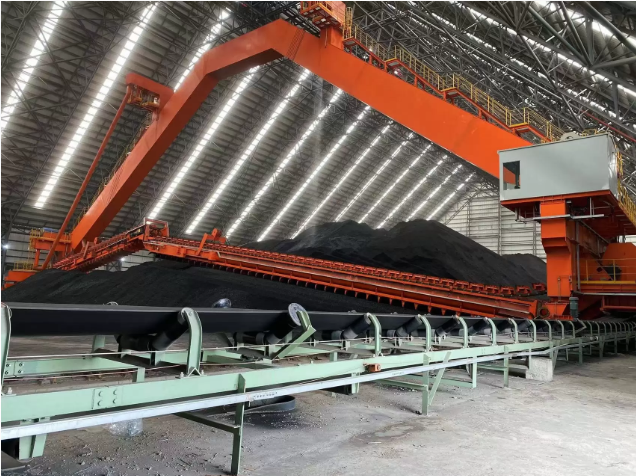
Belt conveyors are widely used for continuous transportation of bulk materials over horizontal or inclined routes. Their relatively high conveying capacity makes them suitable for long-distance transfer in mining, metallurgy, cement production, and power plants. Depending on the application, belt conveyors can be configured with different belt widths, speeds, support structures, and loading arrangements.
Screw conveyors are commonly applied to enclosed transportation of powders, granules, and smaller bulk materials. Their compact structure allows them to be installed in confined spaces and used for controlled feeding, horizontal transfer, or inclined conveying. They are particularly useful where material containment and integration with feeding equipment are important.
Chain conveyors and scraper conveyors are suitable for applications involving heavy materials, abrasive particles, or specific conveying arrangements. Their structural design allows them to handle demanding operating conditions in industrial production. The selection of conveyor type should consider material behavior, conveying distance, required capacity, installation space, and maintenance accessibility.
Matching Conveying Equipment to Material Characteristics
Bulk materials differ significantly in particle size, moisture content, bulk density, abrasiveness, temperature, and flowability. These characteristics influence conveyor capacity, loading conditions, wear patterns, and power requirements. Equipment designed for dry, free-flowing materials may not perform effectively when handling cohesive, wet, or high-temperature materials.
For example, materials with high moisture content may adhere to conveyor surfaces and cause buildup, while abrasive materials can accelerate wear on liners, chains, rollers, and other contact components. Large or irregular particles may require stronger structural components and suitable loading arrangements to prevent impact damage.
A proper conveying solution begins with material analysis and process requirements. Engineers need to evaluate the material's physical properties, expected throughput, transfer points, operating environment, and conveying route. This information helps determine conveyor structure, driving arrangement, conveying speed, protection measures, and supporting equipment, ensuring the system matches the actual production conditions.
System Layout and Conveying Capacity Optimization
The layout of bulk material conveying equipment has a direct influence on production efficiency and plant organization. A system with unnecessary transfer points, excessive conveying distance, or poorly coordinated equipment may increase energy consumption, maintenance workload, and material loss.
An optimized layout considers the relationship between receiving points, intermediate storage, processing equipment, and discharge locations. Conveyor routes should be arranged to minimize unnecessary material movement while providing sufficient space for inspection, maintenance, and component replacement. Elevation changes, installation clearances, and structural support requirements must also be incorporated into the design.
Conveying capacity should be coordinated with the operating capacity of connected equipment. If the conveying system delivers material faster than the downstream process can handle, accumulation and interruptions may occur. Conversely, insufficient conveying capacity can limit production output. Appropriate capacity calculation, speed selection, buffer arrangements, and control coordination help maintain a balanced material flow throughout the processing line.
Equipment Reliability, Wear Protection, and Maintenance
Industrial conveying equipment often operates continuously under heavy loads, dust exposure, vibration, and changing material conditions. Reliability depends on structural strength, component quality, fabrication accuracy, lubrication, installation alignment, and effective maintenance practices.
Wear protection is particularly important when conveying abrasive materials. Conveyor liners, transfer chutes, loading zones, chains, and other components exposed to material impact should be designed according to actual wear conditions. Proper sealing and dust control also help maintain a cleaner operating environment and reduce material loss around transfer points.
Routine inspections should focus on drive systems, bearings, tensioning devices, conveyor alignment, structural connections, lubrication conditions, and wear-prone components. Preventive maintenance based on operating hours and observed equipment conditions helps identify abnormal wear or mechanical issues before they affect production. Accessible inspection points and practical maintenance design can further reduce downtime and servicing costs.
Integration of Conveying Systems with Industrial Production Lines
A bulk material conveying system must work in coordination with the entire production process rather than operate as an isolated machine. Integration with feeders, storage equipment, weighing devices, crushers, screening equipment, and process control systems helps ensure that materials are delivered in the correct quantity and sequence.
Automation can improve conveying efficiency by coordinating equipment start-up and shutdown, regulating feeding rates, monitoring operating conditions, and responding to abnormal signals. Proper control logic and interlocking arrangements help prevent material accumulation, reduce unnecessary equipment operation, and maintain safer working conditions.
For complex industrial installations, engineering coordination is equally important. Equipment interfaces, electrical controls, structural support, installation sequence, and commissioning requirements should be considered during project planning. A conveying system designed around the complete production process is more likely to deliver stable performance and predictable operating results.
Bulk Material Conveying Solutions from Dadi Equipment
Jiangyin Dadi Equipment Co., Ltd. was founded in 2001 and specializes in bulk material conveying equipment and high-end metallurgical equipment. The company has a registered capital of RMB 120 million, covers more than 150 acres, and operates over 70,000 square meters of standardized workshops. With more than 400 employees, including over 100 engineering and management personnel, Dadi Equipment has established substantial manufacturing and technical capabilities for industrial equipment projects.
The company is equipped with advanced processing and production machinery, a comprehensive quality inspection system, and an innovative management framework. Dadi Equipment has implemented ERP management since 2009, an OA office system since 2020, and an MES production management system since 2023, supporting coordination across production planning, manufacturing execution, and management operations.
Its quality and management credentials include ISO 9001 quality management system certification, ISO 14001 environmental management system certification, and ISO 45001 occupational health and safety management system certification. The company also holds qualifications such as AAA Credit Grade Certificate, High and New Technology Enterprise, and Jiangsu Private Science and Technology Enterprise. With hundreds of utility model patents and 16 invention patents, Dadi Equipment continues to strengthen its technical capabilities in equipment design, manufacturing, and industrial application.
For industrial processing facilities requiring dependable bulk material transfer, equipment manufacturing capability, engineering experience, production capacity, and quality control are important factors in supplier selection. Dadi Equipment combines these resources to support bulk material handling and metallurgical equipment requirements across industrial applications.
Conclusion
Efficient bulk material conveying depends on more than conveyor selection. Material properties, system layout, capacity matching, wear protection, maintenance accessibility, and process integration all contribute to reliable material handling performance. When these factors are properly considered during equipment design and manufacturing, industrial plants can achieve smoother material flow, better production coordination, and improved operational efficiency. Working with an experienced equipment manufacturer provides the technical and manufacturing support needed to develop conveying solutions that meet specific process requirements.