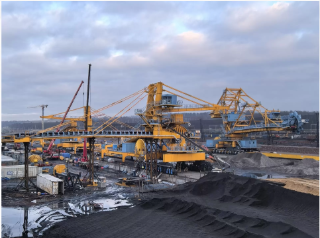
A bucket wheel stacker reclaimer is a large-scale continuous handling machine designed to stack bulk materials into stockpiles and reclaim them when required. By combining stacking and reclaiming functions in one integrated system, it plays an important role in material yards serving steel plants, power stations, ports, mining operations, cement plants, and other heavy industries.
For facilities handling large quantities of coal, iron ore, limestone, pellets, coke, and other bulk materials, the equipment is closely connected with stockyard capacity, material flow, blending, and overall production continuity.
What Is a Bucket Wheel Stacker Reclaimer?
A bucket wheel stacker reclaimer is a rail-mounted bulk material handling machine that combines two primary functions: stacking incoming material and reclaiming material from an existing stockpile. The machine generally consists of a large traveling structure, boom, bucket wheel, conveyor system, slewing mechanism, luffing mechanism, traveling mechanism, and associated electrical and control systems.
During stacking operation, bulk material is transported to the machine through a conveyor system and discharged from the boom to form a stockpile. During reclaiming operation, the bucket wheel rotates against the stockpile, continuously scooping material from the pile and transferring it onto the machine's conveyor system for subsequent transportation.
This integrated arrangement makes the bucket wheel stacker reclaimer particularly suitable for large stockyards where material needs to be stored efficiently and later recovered at a controlled rate. Rather than treating stacking and reclaiming as separate handling processes, the machine coordinates both functions within one engineered system.
How Does a Bucket Wheel Stacker Reclaimer Work?
The operating principle is based on the coordinated movement of several mechanical systems. The bucket wheel continuously rotates and collects material from the stockpile. The collected material is transferred onto a conveyor located on the machine and then discharged to the downstream conveyor system.
The traveling mechanism allows the machine to move along the stockyard rail. This movement determines the machine's position relative to different stockpiles and enables it to cover a large operating area.
The boom provides the necessary reach between the machine structure and the stockpile. Depending on the machine configuration, the boom can be raised or lowered through a luffing mechanism, while slewing movement can adjust the working direction. These movements allow the bucket wheel to work across different sections of the stockpile rather than remaining fixed at one location.
During stacking, the material flow is essentially reversed. Material arrives through the conveyor system, passes through the machine's conveying arrangement, and is discharged through the boom to build the stockpile according to the required stacking pattern.
The result is a continuous material-handling cycle in which transportation, storage, reclaiming, and downstream delivery can be coordinated with the wider plant material flow.
Main Components of a Bucket Wheel Stacker Reclaimer
Bucket Wheel
The bucket wheel is the primary reclaiming component. It consists of multiple buckets mounted around a rotating wheel structure. As the wheel rotates into the stockpile, individual buckets penetrate the material and collect a controlled quantity of bulk material.
The bucket wheel must be designed according to material characteristics, reclaiming capacity, operating conditions, and required wear resistance. Materials such as iron ore and coal can have significantly different bulk densities, particle sizes, abrasiveness, and flow characteristics, so the bucket wheel configuration should be selected accordingly.
Boom Conveyor
The boom conveyor transports material between the bucket wheel and the machine's transfer point. Its design influences the overall material flow and must be coordinated with the bucket wheel capacity and downstream conveying system.
For a combined stacker reclaimer, the boom conveyor may serve both stacking and reclaiming functions. Reliable belt alignment, tension control, drive selection, and structural support are therefore important considerations in equipment design.
Traveling Mechanism
The traveling mechanism allows the complete machine to move along rails installed in the stockyard. Large stockyards require the machine to cover considerable distances while maintaining stable movement and accurate positioning.
The traveling system generally incorporates drive units, wheels, gearboxes, braking components, and associated control equipment. Synchronization between traveling drives is important because uneven movement can create mechanical stress and affect positioning accuracy.
Slewing Mechanism
The slewing mechanism controls the horizontal angular movement of the boom and related working equipment. During operation, the boom needs to reach different sections of the stockpile while maintaining an appropriate relationship with the material flow.
A properly engineered slewing system provides controlled movement and supports accurate positioning during both stacking and reclaiming operations.
Luffing Mechanism
The luffing mechanism changes the vertical angle of the boom. This movement allows the machine to adapt to different stockpile heights and working positions.
Luffing performance needs to correspond with the machine's structural design, boom weight, operating load, and required working range. Hydraulic or mechanical arrangements may be selected according to the equipment configuration and project requirements.
Electrical and Control System
The electrical and control system coordinates the traveling, slewing, luffing, bucket wheel, conveyor, and other auxiliary equipment.
Modern stacker reclaimers can incorporate PLC-based control systems, monitoring devices, protection functions, and automated operating procedures. Dadi Equipment also provides unattended intelligent systems for stacker reclaimers, using equipment positioning, laser scanning, software, and related hardware to support automated stockyard operation.
The control system is not simply an operating interface. It is an important part of the machine's coordination, interlocking, protection, and operational management.
Stacking and Reclaiming: Two Functions in One Machine
The defining characteristic of a bucket wheel stacker reclaimer is its ability to perform both stacking and reclaiming operations.
During stacking, the machine receives bulk material from an upstream conveyor and distributes it over the stockyard. Different stacking patterns can be used depending on stockyard layout, material requirements, and blending objectives.
During reclaiming, the bucket wheel extracts material from the stockpile and transfers it onto the reclaiming conveyor route. The reclaimed material can then be delivered to processing equipment, production lines, transfer stations, or other downstream facilities.
Combining the two functions reduces the need to install completely separate machines for each operation and allows the stockyard to be integrated more closely with the overall material-handling system.
Material Types Commonly Handled
Bucket wheel stacker reclaimers are used for a wide range of bulk materials. The machine configuration, wear protection, bucket design, conveyor parameters, and capacity should be selected according to the physical properties of the material.
Iron Ore
Iron ore is commonly handled in steelmaking raw material yards. Its relatively high bulk density and abrasive characteristics place specific requirements on the bucket wheel, conveyors, structural components, and wear-resistant parts.
A properly designed reclaimer can continuously recover iron ore from stockpiles and feed it into the subsequent material preparation or production process.
Coal
Coal handling systems require continuous and controlled movement between storage yards and power generation or industrial processes. Bucket wheel stacker reclaimers can provide organized stockpiling and controlled reclaiming while integrating with belt conveyor systems.
The design may also take into account dust control, environmental conditions, material flow characteristics, and the operating requirements of the coal yard.
Limestone
Cement plants and related industries commonly store limestone in bulk. Stacker reclaimers can be used to form stockpiles and reclaim limestone for subsequent crushing, grinding, or blending processes.
Where material homogenization is required, the stacking and reclaiming pattern can be coordinated with the stockyard operating strategy.
Pellets, Coke, and Other Bulk Materials
Steel plants may handle pellets, coke, sinter-related materials, and other raw materials through dedicated stockyard systems. Each material has its own density, particle characteristics, abrasiveness, and flow behavior, making equipment configuration an important engineering consideration.
The same basic machine concept can therefore be adapted to different materials through changes in capacity, bucket design, conveyor configuration, structural dimensions, and control parameters.
Key Performance Parameters
Selecting a bucket wheel stacker reclaimer requires more than specifying a nominal capacity. Several technical parameters need to be considered together.
Handling Capacity
Handling capacity is generally expressed in tonnes per hour and indicates how much material the machine can process under defined operating conditions.
The required capacity should be determined according to the material flow of the entire plant. The stacker reclaimer should be properly matched with upstream and downstream conveyor capacities so that the complete system can operate without creating unnecessary bottlenecks.
Stockpile Dimensions
Stockpile length, width, height, and volume directly influence machine dimensions and traveling distance. The equipment should be designed to cover the required stockyard area while maintaining appropriate operating clearances.
Stockpile geometry also affects boom reach, luffing range, bucket wheel position, and reclaiming pattern.
Material Density and Particle Size
Material density affects the mass flow corresponding to a given volumetric capacity. Particle size influences bucket filling, material flow, dust generation, and wear.
These parameters should be clearly defined during the engineering stage because they affect the selection of drives, conveyors, buckets, structural components, and power requirements.
Rail Gauge and Travel Distance
The rail gauge determines the basic dimensions of the traveling structure, while the total rail length determines the machine's operating range.
For an existing stockyard, the machine may need to be designed around established civil works and rail foundations. Customized rail gauge and machine dimensions can therefore be important when replacing or upgrading existing equipment.
Boom Length and Working Range
Boom dimensions determine how far the bucket wheel can reach into the stockpile and how material can be distributed during stacking.
The boom should provide sufficient working coverage without creating unnecessary structural weight or excessive mechanical loads.
Where Are Bucket Wheel Stacker Reclaimers Used?
Steel Plants
Steel production requires large quantities of raw materials to be received, stored, blended, and supplied continuously. Stockyard equipment is therefore an essential part of the raw material handling system.
Bucket wheel stacker reclaimers can manage iron ore, coal, pellets, coke, limestone, and other materials between receiving systems and production facilities.
Power Plants
Coal-fired power plants require dependable coal storage and reclaiming systems. A stacker reclaimer can form organized coal piles and continuously reclaim fuel for the boiler feeding system.
The equipment can be integrated with belt conveyors, transfer towers, crushers, screening equipment, and other components of the coal-handling system.
Mining Operations
Mining facilities often handle substantial quantities of ore and minerals. Stockyards provide temporary storage and controlled material transfer between mining, processing, transportation, and shipping operations.
Bucket wheel reclaimers are particularly suitable where continuous material recovery and large stockpile volumes are required.
Ports and Terminals
Bulk terminals need to move materials between ships, storage yards, and inland transportation systems. A stacker reclaimer can form a central part of the stockyard system by providing controlled storage and retrieval.
The equipment can be integrated with ship unloading systems, belt conveyors, transfer stations, and loading facilities.
Cement Plants
Cement and clinker production involves the storage and handling of limestone, coal, additives, and other bulk materials. Stacker reclaimers can support both material storage and controlled reclaiming while contributing to an organized stockyard layout.
Chemical and Other Bulk Material Industries
Depending on material characteristics and safety requirements, stacker reclaimers can also be applied to fertilizer, potash, phosphate, and other bulk products. The equipment configuration must be adapted to the physical and chemical properties of the handled material.
Bucket Wheel Stacker Reclaimer and Stockyard Management
A stacker reclaimer should be considered as part of a complete stockyard rather than as an isolated machine. Its performance depends on how effectively it interfaces with conveyors, stockpile geometry, material receiving systems, and downstream production equipment.
Stockyard planning should establish clear material routes from receiving to stacking and from reclaiming to final consumption. The machine's travel range, boom movement, stacking pattern, reclaiming rate, and transfer points should all correspond to the physical layout.
This system-level approach is especially important for large industrial projects. A high-capacity machine cannot compensate for an incorrectly sized conveyor or poorly coordinated stockyard arrangement. The mechanical equipment and process design need to work together.
Automation and Intelligent Operation
Automation has become an important component of modern bulk material handling equipment. A stacker reclaimer can incorporate sensors, PLC controls, positioning systems, interlocks, monitoring functions, and automatic operating programs.
For automated operation, the control system can coordinate traveling, slewing, luffing, bucket wheel rotation, and conveyor operation according to predefined operating parameters.
Dadi Equipment provides unattended intelligent system upgrades for stacker reclaimers. According to its technical information, these systems can use laser scanners and related hardware and software to collect and analyze stockyard information, support automatic obstacle avoidance, and enable more accurate reclaiming operations.
Such systems are particularly useful where the stockyard contains multiple material piles and where consistent machine positioning is important.
Structural Design and Wear Protection
A bucket wheel stacker reclaimer operates under substantial mechanical loads. Its main structure must support the weight of the boom, bucket wheel, conveyor, drive components, and material being handled while accommodating traveling, slewing, and luffing movements.
Structural steel selection, welding quality, stress control, mechanical alignment, and manufacturing accuracy all contribute to the machine's operational reliability.
Wear protection is equally important in areas directly exposed to bulk material. Bucket components, liners, chutes, transfer points, and other material-contact parts may require wear-resistant materials according to the abrasiveness and impact characteristics of the handled product.
Dadi Equipment's technical information identifies high-strength low-alloy structural steel and wear-resistant materials for relevant equipment components. The exact material selection should be determined according to the project conditions and engineering requirements.
Integration with Conveyor Systems
The stacker reclaimer does not operate independently from the conveyor network. Material must enter and leave the machine at controlled rates, making conveyor integration one of the key elements of system design.
During stacking, the incoming conveyor must provide a stable material flow to the machine. During reclaiming, the machine's discharge capacity needs to match the downstream conveyor system.
Transfer chutes, belt speeds, belt widths, loading points, and material flow direction should be considered together. Proper integration can reduce material spillage, improve operational continuity, and make maintenance more manageable.
How to Select a Bucket Wheel Stacker Reclaimer
The selection process should begin with the actual material-handling requirement rather than a standard equipment model.
First, define the material type, bulk density, particle size, moisture content, abrasiveness, and expected material flow. These parameters establish the basic requirements for the bucket wheel, conveyor, wear protection, and drive system.
Next, determine the required stacking and reclaiming capacities. The two capacities may not always be identical, so they should be evaluated separately according to the plant's operating process.
The stockyard layout should then be examined, including stockpile dimensions, rail gauge, travel distance, pile height, available space, and civil foundation conditions.
Finally, automation requirements, environmental conditions, electrical standards, maintenance arrangements, and integration with existing equipment should be incorporated into the technical specification.
For a customized project, a professional manufacturer should be able to evaluate these factors as an integrated engineering problem rather than simply supplying a standardized machine.
Jiangyin Dadi Equipment Co., Ltd. — Professional Bulk Material Handling Equipment Manufacturer
Jiangyin Dadi Equipment Co., Ltd. was established in 2001 and specializes in bulk material conveying equipment and high-end metallurgical equipment. The company operates a large manufacturing facility with more than 70,000 square meters of standardized workshops and has more than 400 employees, including over 100 engineering and management personnel.
Dadi Equipment has developed a broad product range for bulk material handling, including bucket wheel stacker reclaimers, semi-portal scraper reclaimers, portal scraper reclaimers, bridge-type scraper reclaimers, cantilever stackers, and tripper carriages.
The company's capabilities extend beyond equipment manufacturing. Dadi provides integrated services covering project consultation, engineering design, manufacturing, installation, commissioning, operator training, after-sales support, spare parts, and equipment improvement or upgrading. This approach enables the equipment supplier to participate in the complete project cycle rather than limiting its role to the manufacture of individual components.
Dadi Equipment has established cooperation with major Chinese steel enterprises and major metallurgical design institutes, while also developing cooperation with internationally recognized engineering and industrial companies. Its equipment has been supplied to customers in more than 30 countries, supporting applications across metallurgy, power generation, ports and terminals, mining, cement, chemical processing, and other bulk material industries.
The company's manufacturing and management systems include ERP, OA, and MES platforms, together with ISO9001 quality management, ISO14001 environmental management, and ISO45001 occupational health and safety management certifications. Dadi also holds numerous utility model and invention patents, reflecting its long-term investment in equipment development and engineering capability.
For customers requiring a bucket wheel stacker reclaimer, this combination of design, manufacturing, control-system integration, installation, and service capability is particularly relevant because stockyard equipment must be engineered around the specific site rather than treated as a completely standardized product.
Dadi Equipment's Approach to Customized Stacker Reclaimer Solutions
Every stockyard has its own combination of material properties, site dimensions, throughput requirements, conveyor arrangements, environmental conditions, and operating procedures. A suitable stacker reclaimer therefore needs to be designed around the actual application.
Dadi Equipment provides customized engineering services to adapt equipment capacity and configuration to customer requirements. This can include the machine's structural dimensions, rail gauge, boom arrangement, handling capacity, control system, electrical configuration, and interface with existing conveying equipment.
The company's turnkey capability covers design, manufacturing, installation, and commissioning, including electrical, hydraulic, and control systems. This integrated approach helps maintain consistency between mechanical equipment and the wider stockyard system.
For projects involving existing stockyards, equipment improvement and upgrading can also be considered. Customized engineering allows new control functions, automation systems, or mechanical modifications to be coordinated with existing site conditions.
Maintenance Considerations
A bucket wheel stacker reclaimer contains numerous mechanical and electrical systems, so maintenance should be organized around the equipment's actual operating cycle.
The bucket wheel and material-contact components should be inspected for wear. Conveyor belts, pulleys, rollers, bearings, gearboxes, couplings, brakes, and drive units require routine inspection according to operating hours and manufacturer specifications.
Traveling rails and wheels should also be monitored because alignment and wheel condition directly affect the movement of the complete machine. Slewing and luffing mechanisms require appropriate lubrication, inspection, and adjustment.
Electrical systems, sensors, control cabinets, safety devices, and communication equipment should be included in preventive maintenance programs. Automated equipment requires particular attention to sensor calibration and control-system diagnostics because accurate machine positioning depends on the reliable interaction of hardware and software.
A structured maintenance program helps identify abnormal conditions before they develop into major equipment interruptions and also supports predictable spare-parts planning.
Frequently Asked Questions About Bucket Wheel Stacker Reclaimers
What is the main purpose of a bucket wheel stacker reclaimer?
Its main purpose is to stack bulk materials into stockpiles and reclaim those materials when required. It combines stacking and reclaiming functions within one continuous bulk material handling machine.
What materials can a bucket wheel stacker reclaimer handle?
Typical materials include iron ore, coal, limestone, pellets, coke, minerals, fertilizers, potash, phosphate, and other bulk materials. The equipment configuration should be selected according to the material's density, particle size, moisture, abrasiveness, and flow characteristics.
How is a bucket wheel reclaimer different from a scraper reclaimer?
A bucket wheel reclaimer uses a rotating wheel fitted with buckets to extract material from a stockpile, while a scraper reclaimer uses scraper chains or similar scraping mechanisms. The appropriate machine depends on stockyard configuration, material characteristics, capacity, and process requirements.
Can a bucket wheel stacker reclaimer be customized?
Yes. Important customizable parameters can include handling capacity, rail gauge, boom dimensions, stockpile geometry, bucket wheel configuration, conveyor arrangement, control system, and automation functions.
Can the machine operate automatically?
Yes. Modern stacker reclaimers can be equipped with PLC-based controls, positioning systems, sensors, interlocks, and automated operating functions. Dadi Equipment also provides unattended intelligent system solutions for applicable stacker reclaimer installations.
What industries use bucket wheel stacker reclaimers?
They are widely used in steel plants, mining operations, power stations, cement plants, ports and terminals, chemical industries, and other facilities that require high-volume storage and continuous handling of bulk materials.
Conclusion
A bucket wheel stacker reclaimer is a central piece of equipment in large-scale bulk material handling systems. Its ability to combine continuous stacking and reclaiming makes it suitable for stockyards where high material throughput, organized storage, and controlled material recovery are essential.
The performance of the machine depends on much more than bucket wheel capacity. Structural design, conveyor configuration, traveling and slewing mechanisms, stockpile geometry, material characteristics, automation, wear protection, and integration with the surrounding conveyor system all contribute to the final solution.
Jiangyin Dadi Equipment Co., Ltd. brings more than two decades of experience in bulk material conveying equipment and high-end metallurgical equipment. With engineering capabilities, manufacturing facilities, quality management systems, customized design services, installation and commissioning support, and experience serving customers in more than 30 countries, Dadi Equipment provides integrated solutions for industrial stockyard and material handling applications.
For projects involving iron ore, coal, limestone, pellets, coke, minerals, or other bulk materials, the right bucket wheel stacker reclaimer should be selected according to the complete operating environment and material flow requirements. A properly engineered machine can become a reliable link between raw material storage, stockyard management, and continuous industrial production.