Efficient bulk material handling starts with properly matched equipment. In steel plants, mining operations, cement plants, power stations, ports, and other heavy industries, the right conveying and stockyard equipment can improve material flow, storage utilization, production coordination, and operating efficiency.
Custom bulk material conveying equipment is designed around the actual material, capacity, stockyard layout, and production requirements rather than relying on a standard machine configuration.
What Is Custom Bulk Material Conveying Equipment?
Custom bulk material conveying equipment refers to machinery engineered according to the specific operating requirements of an industrial facility. Depending on the application, a complete system may include stackers, reclaimers, tripper carriages, transfer equipment, cable reels, winches, dust suppression systems, and associated electrical and control systems.
Bulk materials such as iron ore, lump ore, coal, coke, pellets, flux, limestone, and mineral concentrates have different densities, particle sizes, moisture levels, abrasiveness, and flow characteristics. These differences directly affect equipment selection and operating parameters.
A customized material conveying system takes these factors into account during the engineering stage. Equipment capacity, structural dimensions, traveling distance, discharge position, stockpile geometry, drive system, control configuration, and maintenance access can all be designed according to the project.
For large industrial facilities, this approach allows material handling equipment to function as an integrated part of the production and storage process.
Why Customization Matters in Bulk Material Handling
Industrial plants rarely have identical layouts. Stockyard dimensions, conveyor positions, storage capacity, material flow routes, and available installation space can vary considerably between facilities.
A standard machine may provide the required conveying capacity but still be unsuitable for a particular stockyard because of its dimensions or operating arrangement. Custom engineering allows the equipment to fit the actual site rather than requiring the site layout to be changed around a standard machine.
Capacity is another important consideration. A stockyard may need to handle several thousand tons of material per hour, while the downstream production line may have a different feeding requirement. Stacking, reclaiming, conveying, and production systems therefore need to be coordinated.
For this reason, custom bulk material handling equipment is generally designed as part of an overall material flow system instead of being considered as an independent machine.
Start With Material Characteristics
Material properties are among the most important factors when selecting bulk material conveying equipment.
Iron ore and lump ore can contain large particles and cause significant impact and abrasion. Coal has different flow and dust characteristics, while pellets require careful handling to minimize unnecessary breakage. Coke, flux, limestone, and mineral concentrates each create their own requirements for conveying and storage.
Bulk density, particle size, moisture content, temperature, abrasiveness, angle of repose, and flowability can influence equipment dimensions, drive capacity, discharge arrangements, and wear protection.
For this reason, equipment selection should begin with detailed material information rather than simply choosing a machine based on nominal capacity.
Selecting the Right Stacking Equipment
Stacking equipment distributes bulk materials across a designated stockpile area. A properly configured stacker can improve storage utilization and create a more organized material distribution pattern for subsequent reclaiming operations.
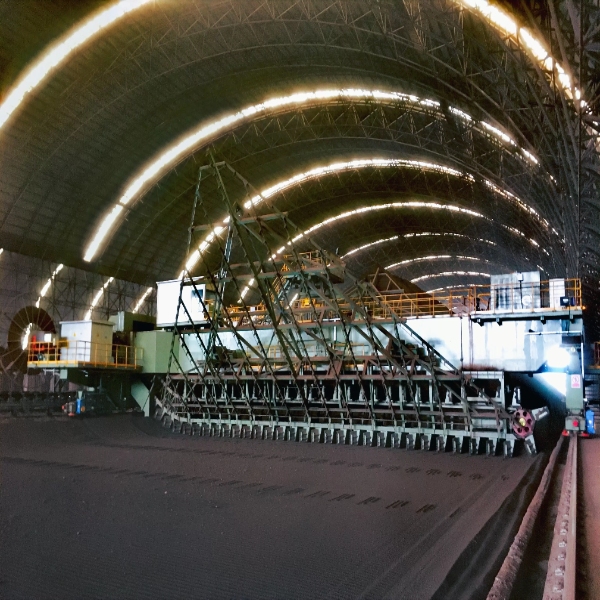
Cantilever stackers and tripper carriages are commonly used for different stockyard configurations. A cantilever stacker can distribute materials over a defined stockpile area, while a tripper carriage travels along a conveyor and discharges material at different positions.
Jiangyin DADI Equipment Co., Ltd. manufactures bulk material handling equipment including cantilever stackers and tripper carriages. Its tripper carriage solutions are designed for materials such as iron powder, lump ore, coal, flux, pellets, and coke, with published stacking capacities ranging from 300 to 7,000 t/h depending on the configuration.
The appropriate stacking solution should be selected according to stockpile dimensions, material properties, required capacity, discharge arrangement, and the overall conveyor system.
Reclaiming Equipment for Controlled Material Recovery
Storing bulk materials is only one part of the material handling process. After a stockpile has been formed, the stored material needs to be recovered at a controlled rate and delivered to the next stage of production.
Reclaimers are designed to recover material from stockpiles and transfer it to the conveying system. Their configuration needs to correspond with the stockpile structure, recovery method, required capacity, and downstream material flow.
Jiangyin DADI Equipment offers several types of reclaiming equipment, including bucket wheel stacker reclaimers, semi-portal scraper reclaimers, portal scraper reclaimers, and bridge-type scraper reclaimers.
Different reclaimer designs serve different stockyard arrangements. Scraper reclaimers can be used for long stockpiles requiring controlled recovery, while portal and semi-portal configurations can be selected according to rail arrangement, stockyard width, pile height, and available installation space.
The correct reclaimer should therefore be selected by considering the complete relationship between stockpile geometry, material characteristics, and required reclaiming performance.
Portal and Semi-Portal Scraper Reclaimers
Portal scraper reclaimers operate across a stockpile and use scraper mechanisms to recover bulk materials. Their structural configuration makes them suitable for large-scale storage yards where systematic material recovery is required.
Semi-portal scraper reclaimers provide an alternative structural arrangement for stockyards with different space and support requirements. The choice between portal, semi-portal, and bridge-type scraper reclaimers depends on factors such as stockpile width, rail positioning, pile height, reclaiming capacity, and site configuration.
During custom engineering, these parameters can be incorporated into the machine design so that the reclaimer works efficiently with the stockpile, conveyor, and material discharge system.
Bucket Wheel Stacker Reclaimers
Bucket wheel stacker reclaimers combine stacking and reclaiming functions in one machine. This configuration is often considered for large stockyards where both material distribution and recovery are required.
The bucket wheel continuously recovers material from the stockpile, while the stacking mechanism distributes incoming material across the storage area.
An integrated stacker reclaimer can help coordinate material storage and recovery while reducing the need for separate machines in certain stockyard layouts. Its suitability depends on material type, capacity, stockpile dimensions, operating requirements, and the overall plant arrangement.
Tripper Carriages for Flexible Material Distribution
A tripper carriage provides a flexible method of distributing bulk materials along a conveyor route. Instead of using a single fixed discharge point, the carriage can travel to different positions and discharge material into designated stockpile areas.
Jiangyin DADI Equipment's tripper carriage products are designed for applications involving iron powder, lump ore, coal, flux, pellets, coke, and other bulk materials. Published specifications include stacking capacities from 300 to 7,000 t/h and rail spans from 2 to 8 meters, depending on the equipment configuration.
This type of equipment is particularly suitable for stockyards that require multiple discharge positions or controlled distribution along an extended storage area.
Customized tripper carriages can also be integrated with discharge chutes, dust suppression equipment, electrical systems, and automated control systems according to project requirements.
Matching Conveying Capacity With Production Requirements
Equipment capacity should always be considered as part of the entire material flow process.
If a reclaimer operates at a higher rate than the downstream conveyor can accept, the system may require operational restrictions. If the conveying capacity is too low for the required production feed rate, the production process may not receive materials consistently.
The same principle applies to stacking systems. The stacker, feeding conveyor, stockpile arrangement, and material receiving system should be designed to work together.
A customized engineering process allows these interfaces to be analyzed before equipment manufacturing, helping ensure that individual machines are properly matched within the complete material handling system.
Structural Design for Heavy Industrial Operation
Bulk material conveying equipment is frequently used in large stockyards and industrial environments where machines are exposed to heavy mechanical loads and repeated operation.
Machine frames, support structures, traveling mechanisms, scraper assemblies, discharge systems, and material-contact components must therefore be designed according to the expected loads and operating conditions.
Jiangyin DADI Equipment states that high-strength low-alloy structural steel is used for major structures, while wear-resistant materials are used for selected critical components.
Structural design can also consider equipment acceleration and braking, material impact, wind loads, temperature conditions, traveling mechanisms, and maintenance requirements.
For large machines, appropriate structural design is essential to maintaining dimensional stability and reliable operation over extended service periods.
Automated Control for Bulk Material Handling
Automation plays an important role in coordinating modern material handling equipment. PLC-based control systems can be used to manage machine movement, stacking positions, reclaiming sequences, interlocks, alarms, and other operating functions.
For large stockyards, automated control can coordinate multiple machines and help establish consistent material handling sequences.
Jiangyin DADI Equipment's product information describes PLC-based control and unattended operation capabilities for selected bulk material handling equipment.
For customized projects, control systems should be developed together with the mechanical and electrical design. The control logic needs to reflect the actual material flow, machine movement, safety interlocks, and operating sequence of the facility.
Dust Control and Environmental Equipment
Dust can be generated when dry bulk materials are transferred, stacked, reclaimed, or discharged. Effective dust management is therefore an important consideration when designing bulk material conveying systems.
Depending on the material and operating conditions, dust control can include enclosed transfer points, optimized discharge chutes, dry mist systems, fog cannon machines, and other suppression solutions.
Jiangyin DADI Equipment provides related equipment including fog cannon machines and dry mist dust suppression systems. These solutions can be integrated with the main conveying and stockyard equipment when required.
The appropriate dust control method depends on material characteristics, transfer height, moisture content, environmental requirements, and the layout of the handling system.
Integrating Mechanical, Hydraulic, Electrical, and Control Systems
A large bulk material handling machine is made up of multiple technical systems. Mechanical structures, drive units, hydraulic components, electrical equipment, sensors, PLC controls, safety systems, and communication interfaces all need to operate together.
Integration should therefore be considered during the initial engineering stage. Mechanical dimensions need to accommodate electrical and hydraulic components, while control systems must correspond with the actual movement and operating sequence of the equipment.
Jiangyin DADI Equipment provides project services covering equipment design, manufacturing, installation, commissioning, and associated electrical, hydraulic, and control systems.
An integrated engineering approach can simplify coordination between different systems and provide a more consistent solution for large-scale material handling projects.
Custom Design Based on Stockyard Layout
Stockyard geometry directly influences the design of conveying and reclaiming equipment.
Important parameters include stockpile length, stockpile width, pile height, rail span, conveyor location, feeding position, reclaiming direction, discharge point, machine travel distance, and available maintenance space.
A long linear stockpile may require a different reclaimer arrangement from a compact storage yard. Similarly, a narrow installation area may require a different structural configuration from a large open stockyard.
Custom engineering allows these conditions to be incorporated into equipment dimensions, traveling mechanisms, discharge systems, and operating parameters.
Bulk Material Handling Applications Across Heavy Industry
Bulk material conveying equipment is widely used in industries where large quantities of loose materials need to be stored, transported, distributed, and recovered.
In steel plants, material handling equipment can be used for iron ore, coal, coke, pellets, flux, and other raw materials. Stable stockyard operation is closely connected with raw material preparation and production feeding.
In mining operations, stackers and reclaimers can support the storage and controlled recovery of ores and minerals. Cement plants can use bulk handling equipment for limestone and other production materials.
Coal handling systems in power plants and bulk storage facilities in ports also require equipment capable of handling high volumes of material while maintaining controlled flow.
Although the basic principles are similar, each application requires equipment configuration to be matched with the specific material and site conditions.
Jiangyin DADI Equipment's Bulk Material Handling Capabilities
Jiangyin DADI Equipment Co., Ltd. was established in 2001 and specializes in high-end metallurgical equipment and bulk material conveying equipment.
According to the company's published information, the company has more than 400 employees, including more than 100 engineers and management personnel, and operates standardized production workshops covering more than 70,000 square meters.
Its bulk material handling product range includes bucket wheel stacker reclaimers, semi-portal scraper reclaimers, portal scraper reclaimers, bridge-type scraper reclaimers, cantilever stackers, and tripper carriages.
The company also supplies related equipment such as cable reels, chains, fog cannon machines, winches, and unattended systems.
Its service scope covers project consulting, customized equipment design and manufacturing, installation and commissioning, operator training, after-sales service, spare parts support, and equipment improvement or upgrading.
The company's published information also states that its equipment has been supplied to major Chinese steel enterprises and that it has cooperated with international engineering and industrial companies including Danieli, SMS, Voestalpine, Nippon Steel, and POSCO. Its equipment has been exported to customers in more than 30 countries.
Key Specifications to Define Before Ordering Custom Equipment
A detailed technical specification can make the design and quotation process more efficient.
The material type should be clearly identified, including bulk density, particle size, moisture content, temperature, abrasiveness, and other relevant characteristics.
Required capacity should be specified in tons per hour, including normal operating capacity and any required peak capacity.
Stockyard information should include pile length, width, height, rail span, equipment travel distance, conveyor location, and available installation space.
The required operating mode should also be defined. Some facilities need fixed-position stacking, while others require traveling stackers, automated reclaiming, or coordinated operation of multiple machines.
Electrical power supply, control requirements, communication interfaces, environmental conditions, dust suppression requirements, and maintenance access should also be considered during the equipment design stage.
Providing complete technical information allows the manufacturer to develop a configuration that is more closely aligned with the actual application.
Equipment Manufacturing and Project Support
For large industrial material handling projects, equipment manufacturing is only one stage of the overall process. Installation, commissioning, operator training, spare parts, maintenance, and technical support can also influence the long-term operation of the system.
Jiangyin DADI Equipment's stated service scope covers project consulting, design and manufacturing, installation and commissioning, instruction and training, after-sales service, equipment improvement, and upgrading.
This integrated service model can be useful when customized equipment needs to be connected with an existing production line. Equipment interfaces, control requirements, and operating procedures can be considered throughout the project.
Improving Material Flow Through Customized Equipment
The main purpose of customized bulk material conveying equipment is to create a more coordinated material flow within the facility.
A properly designed system can reduce unnecessary material transfers, improve stockyard utilization, coordinate stacking and reclaiming operations, and provide a more consistent material supply for downstream production.
Equipment can also be adapted to the actual material flow instead of requiring operators to work around limitations associated with a standard machine.
For high-volume industrial facilities, better coordination between equipment can contribute to more efficient operation, easier maintenance planning, improved equipment utilization, and smoother production management.
Conclusion
Custom bulk material conveying equipment provides industrial facilities with a practical way to match material handling machinery with actual production requirements. Instead of selecting equipment based only on nominal capacity, manufacturers and plant operators should consider material characteristics, stockyard geometry, throughput, machine configuration, structural requirements, control systems, and downstream production needs as an integrated system.
Stackers, reclaimers, tripper carriages, conveyors, dust suppression equipment, and control systems each have a specific function within the overall material handling process. Proper engineering ensures that these individual components work together efficiently.
Jiangyin DADI Equipment Co., Ltd. focuses on high-end metallurgical equipment and bulk material conveying solutions, offering equipment for stacking, reclaiming, conveying support, dust suppression, control integration, installation, commissioning, and after-sales service.
For companies planning a new stockyard, expanding material handling capacity, or upgrading an existing conveying system, customized equipment provides a way to align machinery with actual material properties, site dimensions, production capacity, and operating requirements. A detailed understanding of material flow is the foundation for developing an efficient and reliable industrial material handling system.