Industrial production depends on the reliable movement of large quantities of raw materials. From iron ore and coal to limestone, clinker, minerals, and other bulk solids, efficient conveying and storage are essential for keeping material yards and production lines operating smoothly.
Industrial bulk material conveying equipment provides the mechanical systems needed to transport, stack, reclaim, distribute, and manage these materials. Different equipment configurations can be combined according to material characteristics, storage capacity, conveying distance, production requirements, and site layout.
What Is Industrial Bulk Material Conveying Equipment?
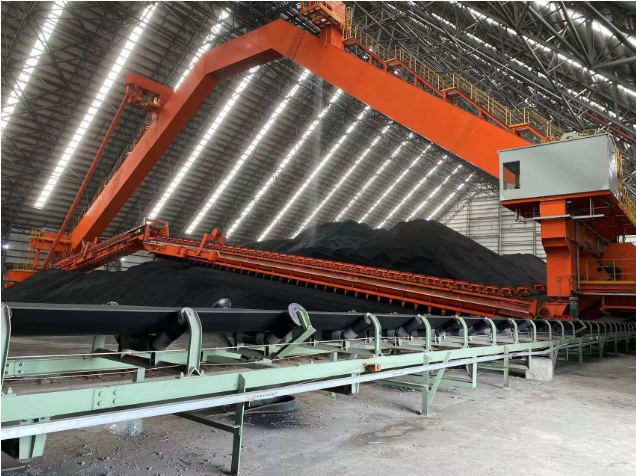
Industrial bulk material conveying equipment refers to a group of machines and integrated systems designed to handle large quantities of loose or granular materials. Unlike equipment designed for packaged goods, bulk material handling systems work with materials that are stored in piles, bins, yards, silos, or other large-capacity storage areas.
Typical bulk materials include iron ore, coal, limestone, coke, mineral concentrates, cement raw materials, aggregates, and various industrial powders and granules. Depending on the application, the material may need to be transported over a fixed route, distributed evenly across a storage yard, reclaimed from a stockpile, or continuously supplied to another production process.
A complete bulk material handling system may include conveyors, stackers, reclaimers, tripper cars, feeders, transfer points, electrical systems, hydraulic systems, dust-control equipment, and automated control systems. The equipment is normally selected as an integrated solution rather than as isolated machines.
Main Functions of Bulk Material Handling Systems
The basic functions of an industrial bulk material handling system can be divided into conveying, stacking, reclaiming, feeding, and distribution.
Conveying moves material from one location to another. Stacking places incoming material into organized stockpiles, while reclaiming removes stored material and sends it back into the production or transportation process.
A well-designed system connects these functions into a continuous material flow. For example, material arriving by ship, rail, or truck can be transferred to a conveyor, moved to a stockyard, distributed by a stacker, stored for a specific period, and later recovered by a reclaimer for delivery to a processing plant.
This integrated approach is especially important in steel plants, mining operations, power stations, cement plants, ports, and other facilities where production depends on a stable supply of bulk raw materials.
Belt Conveyor Systems for Bulk Material Conveying
Belt conveyors are among the most widely used technologies for industrial bulk material transportation. They can move large quantities of material continuously and can be configured for different conveying distances, capacities, and site conditions.
A typical belt conveyor system consists of a conveyor belt, drive unit, pulleys, idlers, supporting structure, take-up system, and related electrical and control components. Transfer stations are commonly used when material needs to move between different conveyor sections.
For bulk material handling, conveyor design must take into account factors such as material density, particle size, moisture content, conveying capacity, belt speed, inclination, and the required transfer arrangement.
Belt conveyors are often integrated with stacking and reclaiming equipment in large stockyards. This allows materials to move continuously from receiving points to storage areas and from storage areas back into production.
Stacker Systems for Material Storage
Stackers are designed to distribute bulk materials into stockpiles. They are particularly useful when large quantities of material need to be stored in an organized and accessible manner.
A cantilever stacker, for example, can receive material from a conveyor and place it onto a stockpile while moving along a defined path. By controlling the position of the discharge boom, the equipment can build stockpiles with greater storage efficiency.
Stacking equipment is commonly used in steel plants, mining facilities, ports, power plants, and other industrial sites. Proper stacking helps make better use of available yard space and provides a controlled material storage process.
The choice of stacking method depends on the available yard area, stockpile geometry, material characteristics, required storage volume, and connection with upstream and downstream conveying equipment.
Bucket Wheel Stacker Reclaimers
Bucket wheel stacker reclaimers combine stacking and reclaiming functions in one machine. This type of equipment can place material into a stockpile and later recover it from the same storage area.
The bucket wheel uses multiple buckets mounted around a rotating wheel to continuously remove material from the stockpile. The recovered material is transferred through the machine onto a conveyor system.
Bucket wheel stacker reclaimers are widely associated with large bulk material yards because they can handle high material volumes while performing both storage and recovery operations.
They are particularly suitable for applications where continuous material flow and large stockpile capacity are important. Their integration with yard conveyors can create an efficient route between receiving systems, storage areas, and production facilities.
Scraper Reclaimers for Bulk Material Handling
Scraper reclaimers use scraping mechanisms to remove bulk material from stockpiles. They are designed to recover material in a controlled and continuous manner and can be configured for different stockpile arrangements.
There are several types of scraper reclaimers, including semi-portal scraper reclaimers, portal scraper reclaimers, and bridge-type scraper reclaimers. Each configuration has its own structural arrangement and operating range.
A semi-portal scraper reclaimer is often suitable for stockyards where the machine needs to operate over a defined stockpile area while maintaining an efficient structural arrangement. Portal scraper reclaimers provide another configuration for large material storage yards, while bridge-type scraper reclaimers are designed around a bridge structure spanning the stockpile.
The appropriate reclaimer depends on stockpile dimensions, material properties, reclaiming capacity, yard configuration, and the relationship between the stockpile and the conveyor system.
Semi-Portal Scraper Reclaimer
A semi-portal scraper reclaimer is designed to reclaim material from stockpiles using a scraper mechanism supported by a semi-portal structure.
This equipment can provide controlled stockpile reclaiming and is suitable for industrial facilities where material must be recovered continuously or according to a defined production schedule.
Semi-portal scraper reclaimers are commonly considered for steel plants, raw material yards, power stations, cement facilities, and other applications involving large quantities of stored bulk solids.
The machine can be integrated with conveyor systems so that reclaimed material is transferred directly from the stockpile to the next processing or transportation stage.
Portal Scraper Reclaimer
A portal scraper reclaimer uses a portal-type supporting structure to span the material storage area. The scraper system moves along the stockpile and transfers reclaimed material toward the discharge conveyor.
This configuration is useful for large stockyards where a structured reclaiming system is required across a wide storage area.
Portal scraper reclaimers can be engineered according to specific stockpile dimensions and required reclaiming capacity. Their integration with conveyors, electrical controls, and other auxiliary equipment makes them suitable for complete bulk material handling systems.
Bridge-Type Scraper Reclaimer
Bridge-type scraper reclaimers use a bridge structure spanning the stockpile. A scraper mechanism mounted on the bridge removes material from the pile and directs it toward the reclaiming system.
This design can provide stable and organized stockpile reclaiming, particularly in large industrial material yards.
The bridge structure, scraper arrangement, drive system, and discharge system must be designed according to the dimensions and physical characteristics of the stockpile. Material density, particle size, moisture, and required reclaiming capacity are important factors when selecting the equipment.
Tripper Carriage for Material Distribution
A tripper carriage is used to distribute bulk material from a conveyor to different locations along a material storage or processing area.
Instead of directing all incoming material to one fixed discharge point, a tripper carriage can move along a defined track and discharge material at selected locations. This makes it useful for filling multiple stockpile positions or feeding different storage areas.
Tripper carriages can be integrated into larger conveyor systems and controlled according to the required material distribution pattern. Their use can improve the flexibility of bulk material storage and help connect conveying systems with different stockyard arrangements.
Cable Reels, Winches, and Auxiliary Equipment
Bulk material conveying systems require more than the primary stacker, reclaimer, or conveyor. Auxiliary equipment plays an important role in providing power, movement, control, and operational support.
Cable reels can supply electrical power to mobile equipment such as stackers and reclaimers. Winches can be used for specific movement and mechanical support applications, while chains and other mechanical components contribute to the transmission and operation of bulk material handling equipment.
Dust suppression equipment can also be incorporated into bulk material handling facilities. For materials that generate dust during transfer or stacking, suitable dust-control equipment helps maintain a cleaner working environment and supports site management requirements.
Unattended operating systems can also be integrated into modern material handling equipment to reduce the need for continuous manual intervention in selected operating processes.
Material Handling Applications in the Steel Industry
The steel industry is one of the major users of industrial bulk material conveying equipment. Steel production requires large volumes of raw materials, including iron ore, coal, coke, limestone, and other additives.
These materials often pass through several stages before reaching the production process. They may be received at a raw material yard, transported by conveyors, stacked into stockpiles, reclaimed when required, and delivered to the next stage of production.
Reliable conveying and reclaiming equipment is therefore closely connected to stable steel production. Stacker reclaimers, scraper reclaimers, tripper carriages, and conveyor systems can work together to provide controlled material storage and continuous supply.
For large steel plants, the material handling system is normally designed around the plant's production capacity, storage requirements, raw material flow, and overall site layout.
Applications in Mining and Mineral Processing
Mining operations generate and consume large quantities of bulk materials. Ore, concentrates, coal, crushed rock, and other minerals often need to be transported and stored before processing or shipment.
Bulk material conveying equipment allows these materials to move between mining, crushing, screening, stockpiling, processing, and loading areas.
Stackers can build large stockpiles, while reclaimers recover material for processing or transportation. Conveyor systems connect these machines and provide continuous material movement over long distances.
Because mining operations often involve abrasive materials and high material throughput, equipment selection should take into account material density, particle size, abrasion characteristics, and required operating capacity.
Applications in Cement and Building Materials
Cement plants and building material facilities handle raw materials such as limestone, clay, gypsum, coal, and other mineral-based materials.
These materials are frequently stored in large stockpiles before being processed or used in production. Bulk material conveying systems can move the materials between receiving points, storage yards, crushers, mills, and production areas.
Stacking and reclaiming equipment can also help maintain an organized raw material inventory. By controlling the movement of materials through the storage area, plants can establish a more predictable supply to downstream processes.
Applications in Power Plants
Power generation facilities that use solid fuels require reliable material receiving, storage, and feeding systems. Coal and other bulk fuels may need to be transported from unloading facilities to storage yards and then reclaimed for delivery to the power generation process.
Bulk material conveyors provide continuous transportation, while stackers and reclaimers manage large outdoor or covered storage areas.
The conveying system must be matched to the required fuel throughput and storage capacity. Equipment layout is also important because the material yard needs to connect efficiently with receiving systems and fuel preparation or feeding systems.
Bulk Material Handling in Ports and Terminals
Ports and bulk cargo terminals handle materials such as coal, iron ore, mineral concentrates, grain, aggregates, and other bulk commodities.
In these facilities, material may move from ships to stockyards or from stockyards to ships. Conveying equipment provides the connection between unloading, storage, reclaiming, and loading systems.
High-capacity stackers and reclaimers can help organize large storage yards, while tripper systems and conveyors provide controlled material distribution.
The equipment layout must be carefully coordinated with berth locations, stockpile dimensions, conveyor routes, and loading or unloading capacity.
Choosing the Right Bulk Material Conveying Equipment
Selecting industrial bulk material conveying equipment requires an understanding of the complete material flow rather than focusing on one machine.
Material properties are one of the first considerations. Bulk density, particle size, moisture, temperature, abrasiveness, and flowability can all influence equipment selection and design.
Required capacity is another major factor. A system designed for a relatively low material flow will have different equipment dimensions and operating parameters from a high-capacity steel or mining application.
The stockyard layout also affects the selection. Available land, stockpile dimensions, conveyor routes, equipment travel paths, discharge locations, and maintenance access should all be considered during system design.
Operating requirements are equally important. Some facilities require continuous operation, while others work according to scheduled batches or production cycles. The conveying equipment should therefore match the actual material flow requirements of the facility.
The Importance of Integrated System Design
A bulk material conveying system performs best when its individual machines are designed to work together.
For example, a conveyor must be compatible with the capacity of the stacker receiving the material. The stacker must be able to distribute material according to the stockpile arrangement, while the reclaimer must recover material at a rate that matches the downstream conveyor and production process.
Electrical, hydraulic, mechanical, and control systems also need to work as an integrated system. Poor coordination between individual pieces of equipment can affect the overall material flow even when each machine performs properly on its own.
For this reason, industrial customers often prefer suppliers capable of providing complete engineering, manufacturing, installation, commissioning, and control integration.
DADI Equipment: Bulk Material Conveying and Reclaiming Solutions
Jiangyin DADI Equipment Co., Ltd. was founded in 2001 and focuses on high-end metallurgical equipment and bulk material conveying equipment. The company operates a standardized manufacturing facility of more than 70,000 square meters and has more than 400 employees, including more than 100 engineering and management personnel. Its equipment and services cover bulk material handling as well as auxiliary equipment for steel rolling lines.
DADI's bulk material conveying equipment portfolio includes bucket wheel stacker reclaimers, semi-portal scraper reclaimers, portal scraper reclaimers, bridge-type scraper reclaimers, cantilever stackers, and tripper carriages. The company also supplies auxiliary equipment such as cable reels, chains, fog cannon machines, winches, and unattended systems.
One notable feature of DADI's approach is its ability to provide turnkey services covering equipment design, manufacturing, installation, commissioning, electrical systems, hydraulic systems, and control systems. This type of integrated service can be particularly valuable for large industrial projects where conveying equipment must be coordinated with the wider production and material storage system.
DADI has also established cooperation with major steel enterprises and international engineering and equipment companies. Its products have been supplied to customers in more than 30 countries, reflecting its experience in industrial bulk material handling and metallurgical equipment.
Customized Bulk Material Handling Solutions
There is no single conveying configuration that is suitable for every industrial site. A steel plant raw material yard, a mining stockyard, and a port terminal may all handle bulk materials but have very different operating requirements.
Customized equipment design allows the system to be adapted to specific material characteristics, storage capacity, conveying distance, reclaiming capacity, stockpile dimensions, and site conditions.
For example, the required scraper reclaimer configuration may change according to stockpile width and height. Similarly, the arrangement of stackers and tripper carriages depends on how material is distributed throughout the yard.
Engineering customization can also cover electrical control systems, hydraulic systems, conveyor interfaces, safety functions, and equipment automation. The goal is to create a complete material handling system that fits the production process rather than forcing the facility to adapt to a standard machine configuration.
Installation, Commissioning, and After-Sales Service
Large bulk material handling equipment requires careful installation and commissioning because many systems involve large mechanical structures, moving components, electrical equipment, hydraulic systems, and control systems.
During commissioning, equipment movement, conveyor interfaces, material flow, electrical controls, hydraulic functions, safety systems, and operating parameters are checked before normal production begins.
Operator training is also an important part of the process. Proper understanding of equipment operation, inspection procedures, routine maintenance, and safety requirements helps plant personnel use the system effectively.
DADI provides project consulting, design and manufacturing, installation and commissioning, operator instruction and training, after-sales maintenance, spare parts support, and equipment improvement services as part of its overall project service capabilities.
Maintenance of Bulk Material Conveying Equipment
Regular maintenance is essential for keeping bulk material handling systems operating reliably. Conveyors, stackers, reclaimers, tripper carriages, drives, hydraulic systems, electrical components, and structural assemblies all require appropriate inspection.
Wear components should be checked according to operating conditions and material characteristics. Lubrication, belt condition, scraper condition, bearings, drive systems, electrical connections, and hydraulic components should also be included in planned maintenance programs.
For reclaimers and stackers, particular attention should be given to moving mechanisms, scraper systems, bucket wheels where applicable, travel systems, and structural components.
A planned maintenance approach helps identify abnormal wear and mechanical problems before they interfere with material flow or production operations.
Automation and Control Systems
Modern bulk material conveying systems rely heavily on electrical and control systems. Automated controls can coordinate conveyors, stackers, reclaimers, tripper carriages, and other equipment according to the required material flow.
Control systems can manage equipment start-up and shutdown sequences, travel positions, material distribution, interlocking functions, and selected operating parameters.
For large stockyards, automated operation can also help coordinate multiple machines and reduce unnecessary manual intervention. Sensors and control logic can provide operating information that supports equipment management and production scheduling.
DADI's project services include electrical, hydraulic, and control system integration, allowing these elements to be considered together with the mechanical equipment during system design and commissioning.
Conclusion
Industrial bulk material conveying equipment is a fundamental part of many large-scale production and logistics facilities. From belt conveyors and tripper carriages to cantilever stackers, bucket wheel stacker reclaimers, and scraper reclaimers, each type of equipment performs a specific function within the overall material flow.
The most effective solution is usually a complete system in which conveying, stacking, storage, reclaiming, control, and auxiliary equipment work together according to the site's material characteristics and production requirements.
With experience in bulk material conveying equipment and high-end metallurgical machinery, DADI Equipment provides equipment and integrated services for applications including steel production, mining, ports, power generation, cement, and other bulk material industries. Its range of stackers, reclaimers, tripper carriages, and supporting equipment provides flexible options for different material yard configurations and conveying requirements.
For industrial facilities handling large quantities of bulk materials, selecting the right conveying and reclaiming technology is an important part of establishing a stable, efficient, and well-organized material handling process.