Bulk material conveying equipment plays an important role in industries that move large quantities of coal, iron ore, limestone, minerals, coke, and other raw materials. Choosing the right manufacturer or supplier is not simply about comparing equipment prices. Engineering capability, manufacturing quality, equipment configuration, customization, installation support, and after-sales service all have a direct impact on the performance of a complete material handling system.
For steel plants, mining operations, cement plants, power stations, ports, and large industrial stockyards, working with an experienced bulk material conveying equipment manufacturer can make equipment selection and project implementation much more efficient.
What Does a Bulk Material Conveying Equipment Manufacturer Do?
A professional bulk material conveying equipment manufacturer does much more than manufacture individual machines. The supplier usually participates in equipment selection, mechanical design, manufacturing, assembly, testing, installation, commissioning, and technical support.
Bulk material handling systems can contain several interconnected machines. Depending on the project, the system may include stackers, scraper reclaimers, bucket wheel stacker reclaimers, tripper carriages, conveyors, cable reels, chains, winches, dust-control equipment, and automated control systems.
Because these machines operate as part of one material flow, the manufacturer's engineering ability is particularly important. Equipment capacity, stockpile dimensions, conveyor interfaces, travel distances, discharge positions, electrical systems, and control functions need to be coordinated before production begins.
A capable supplier can therefore help customers move from individual equipment requirements to a complete and practical material handling solution.
Why Manufacturer Selection Matters
The quality of bulk material conveying equipment directly affects material flow and plant operation. A reclaimer with insufficient capacity, for example, may restrict downstream production even if the rest of the conveying system has adequate capacity.
Manufacturing precision also matters because large bulk material machines contain numerous mechanical and structural components that must work together. Drive systems, bearings, scraper chains, travel mechanisms, hydraulic systems, electrical components, and steel structures all need to meet the required specifications.
An experienced manufacturer understands these relationships and can evaluate the equipment as part of the entire process. This is particularly valuable for large projects where the conveying equipment is connected to production lines, storage yards, ports, or other material handling facilities.
Key Equipment Offered by Bulk Material Handling Suppliers
Bulk material conveying equipment suppliers typically provide several categories of equipment. The exact product portfolio varies by manufacturer, but major equipment generally includes reclaimers, stackers, and material distribution machines.
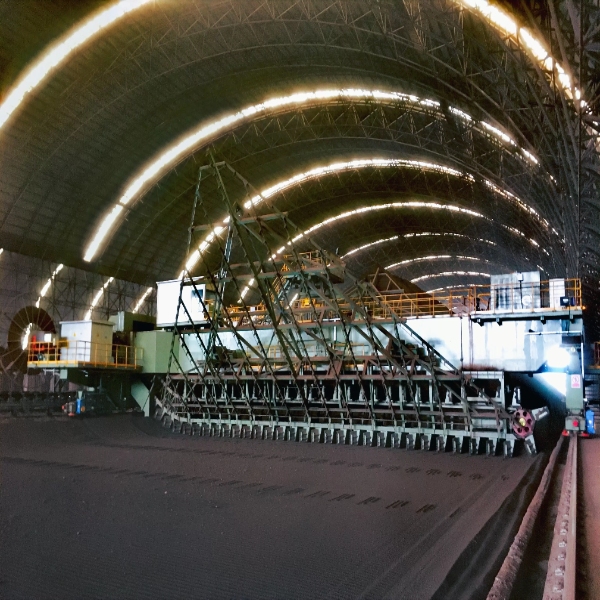
Reclaiming equipment removes stored bulk material from stockpiles and returns it to a conveyor or processing system. Common designs include bucket wheel stacker reclaimers, semi-portal scraper reclaimers, portal scraper reclaimers, and bridge-type scraper reclaimers.
Stacking equipment places incoming material into stockpiles. Cantilever stackers and tripper carriages are commonly used for controlled material distribution in storage yards.
Supporting equipment can include cable reels, heavy-duty chains, winches, dust suppression equipment, and unattended operating systems. A supplier capable of providing several related equipment types can often coordinate the interfaces more effectively within a complete project.
Bucket Wheel Stacker Reclaimers
Bucket wheel stacker reclaimers combine material stacking and reclaiming functions in one machine. The bucket wheel continuously cuts material from the stockpile, while the conveyor system transfers the recovered material toward the discharge point.
These machines are commonly used in large raw material yards where high-volume storage and retrieval are required. They can be configured according to stockpile dimensions, material characteristics, reclaiming capacity, and yard layout.
For customers comparing bulk material equipment manufacturers, it is important to examine not only the machine's rated capacity but also the manufacturer's experience with structural design, drive systems, bucket wheel mechanisms, travel systems, control systems, and project integration.
Scraper Reclaimers for Industrial Stockyards
Scraper reclaimers use a scraper mechanism to remove bulk material from a stockpile. They are widely used in applications where controlled and continuous reclaiming is required.
Semi-portal scraper reclaimers, portal scraper reclaimers, and bridge-type scraper reclaimers provide different structural configurations for different stockyard arrangements. The choice depends on factors such as stockpile width, stockpile height, reclaiming capacity, rail arrangement, material properties, and available space.
A reliable manufacturer should be able to customize the structural and mechanical configuration according to the actual project rather than simply offering a standard machine.
Cantilever Stackers and Material Distribution
Cantilever stackers are used to place bulk materials into stockpiles while maintaining a defined discharge area. The cantilever structure provides the reach needed to distribute material efficiently across the storage area.
For industrial stockyards, the stacker must be compatible with the incoming conveyor system and the dimensions of the stockpile. The boom length, travel arrangement, discharge capacity, and control system all influence the overall material distribution process.
When purchasing from a manufacturer, customers should therefore consider the stacker as part of the complete conveying system rather than as a standalone machine.
Tripper Carriage Systems
A tripper carriage is designed to discharge material from a conveyor at selected locations. It can move along a defined track and distribute bulk material to different sections of a storage area or production facility.
Tripper carriages are useful when one conveyor needs to serve several storage positions. Depending on the project, they can be customized to suit existing conveyor structures, rail gauges, discharge points, and material capacity requirements.
The quality of the travel mechanism, discharge arrangement, structural design, electrical system, and control configuration can all influence the reliability of the equipment.
What Defines a High-Quality Bulk Material Equipment Manufacturer?
Quality in bulk material handling equipment begins with engineering and continues throughout manufacturing, assembly, inspection, installation, and commissioning.
A manufacturer should have appropriate production facilities for large steel structures and heavy mechanical components. It should also have a quality inspection system capable of checking critical dimensions, welding quality, mechanical assemblies, electrical components, and finished equipment.
Engineering experience is equally important. A technically capable manufacturer can identify how material properties, stockpile geometry, operating capacity, and equipment configuration affect one another.
Quality management systems can provide additional assurance that manufacturing procedures are controlled. However, customers should also consider actual project experience, production capacity, engineering personnel, and the supplier's ability to provide technical support throughout the equipment lifecycle.
Manufacturing Capability and Production Capacity
Large bulk material handling machines require substantial manufacturing space and specialized equipment. Structural components may be large and heavy, while mechanical assemblies require precision machining and controlled installation.
A supplier with its own standardized manufacturing facilities can have greater control over production schedules, assembly quality, inspection, and equipment integration.
Jiangyin DADI Equipment Co., Ltd., for example, was established in 2001 and focuses on bulk material conveying equipment and high-end metallurgical equipment. According to the company's official profile, DADI has more than 70,000 square meters of standardized workshops and more than 400 employees, including more than 100 engineering and management personnel.
This type of manufacturing infrastructure is relevant when evaluating suppliers for large-scale material handling projects because production capacity must match the size and complexity of the equipment being ordered.
Engineering and Custom Design Capability
Bulk material conveying equipment rarely fits every project in exactly the same configuration. Even two steel plants handling similar materials may have different stockyard dimensions, conveyor routes, production capacities, and site conditions.
Customization can involve equipment dimensions, rail gauge, travel distance, reclaiming capacity, stacking range, conveyor interfaces, electrical systems, hydraulic systems, and control systems.
A capable manufacturer should be able to review the customer's technical specifications and develop equipment around the actual application.
For example, the design of a scraper reclaimer can be adjusted according to stockpile width and height, while a tripper carriage can be designed around the existing conveyor and discharge locations.
This engineering flexibility is one of the most important differences between a specialized equipment manufacturer and a general machinery supplier.
Material Characteristics and Equipment Selection
The bulk material itself has a major influence on equipment design. Coal, iron ore, limestone, coke, fertilizer, and mineral concentrates have different densities, particle sizes, moisture levels, flow characteristics, and abrasive properties.
Iron ore, for instance, can place significant wear demands on components that come into direct contact with the material. Moist materials may behave differently during reclaiming and transfer compared with dry granular materials.
A professional supplier should therefore ask for detailed information about the material before recommending equipment. Important parameters can include bulk density, particle size distribution, moisture content, material temperature, abrasiveness, and required throughput.
Correct material information helps engineers select appropriate scraper systems, chains, wear-resistant components, drive systems, and conveying capacities.
Capacity Is More Than a Single Number
When comparing bulk material conveying equipment suppliers, rated capacity should not be considered in isolation.
A material handling system needs to maintain a suitable relationship between receiving capacity, stacking capacity, storage capacity, reclaiming capacity, and downstream conveying capacity. If one section has a substantially lower capacity than the rest of the system, it can become a limiting point.
Manufacturers should therefore evaluate the complete material flow when determining equipment specifications.
The required capacity may also vary depending on whether the material handling system is designed for continuous production, batch operation, stockpile management, or scheduled loading and unloading.
Structural Design for Heavy-Duty Applications
Bulk material handling machines often operate in large outdoor stockyards and are exposed to substantial mechanical loads. Their structural design must account for equipment weight, material loads, operating forces, travel forces, and local environmental conditions.
High-strength structural steel can be used for major machine components, while wear-resistant materials are often applied to areas exposed to continuous material contact.
The design of rails, wheels, frames, booms, bridges, support structures, scraper mechanisms, and other components must be coordinated to ensure that the machine operates as intended.
For customers selecting a manufacturer, structural engineering experience is therefore an important consideration, particularly for large portal and bridge-type machines.
Drive Systems and Mechanical Components
The drive system is a critical part of bulk material conveying equipment. Motors, reducers, couplings, bearings, chains, wheels, shafts, and other mechanical components work together to provide movement and material handling functions.
Component selection should correspond to the equipment's operating load and duty cycle. Components used in high-load applications require appropriate strength and wear resistance.
A manufacturer with strong mechanical engineering capabilities can also design the transmission system around the complete machine rather than selecting components independently.
This approach helps maintain compatibility between the drive system, machine structure, operating speed, and required material capacity.
Electrical and Control Systems
Modern bulk material handling equipment relies on electrical and control systems to coordinate movement and material flow.
Control functions can include equipment start and stop sequences, travel control, interlocking, position management, material distribution, alarm functions, and selected automated operating processes.
For a large stockyard, the control system may need to coordinate several conveyors and mobile machines. This requires proper communication between mechanical and electrical engineering teams.
DADI states that its turnkey services cover equipment design and manufacturing as well as installation and commissioning, including electrical, hydraulic, and control systems.
Having these disciplines handled within one project structure can simplify technical coordination and commissioning.
Wear Resistance and Component Selection
Bulk materials can be highly abrasive, particularly in mining and metallurgical applications. Components that directly contact the material may therefore experience substantial wear.
Wear-resistant materials can be used for scraper components, chains, liners, chutes, and other high-contact areas. Heavy-duty chains are especially important in scraper reclaimers because they operate under repeated loads while moving through abrasive material.
The selection of wear-resistant components should be based on actual material properties and operating conditions. Choosing components solely according to initial purchase price may not provide the best overall equipment performance.
Quality Inspection During Manufacturing
Quality inspection should take place throughout the manufacturing process rather than only after the machine has been completed.
Structural components can be inspected during fabrication, while machined parts can be checked for dimensions and tolerances. Mechanical assemblies should be inspected for proper installation and alignment.
Electrical and hydraulic systems also require functional testing before delivery. For large equipment, factory assembly and testing can help identify interface problems before the machine reaches the customer's site.
DADI's official company information highlights its production equipment, quality inspection system, and management systems. The company reports ISO9001 quality management, ISO14001 environmental management, and ISO45001 occupational health and safety certifications.
Installation and Commissioning Services
Large bulk material conveying equipment often requires specialized installation because of its size and mechanical complexity.
Installation involves structural assembly, mechanical alignment, electrical connections, hydraulic connections, conveyor interfaces, control system setup, and functional testing.
Commissioning then verifies that individual components and the complete system operate according to the required specifications.
For international projects, an equipment supplier that provides installation and commissioning support can make project coordination easier. DADI lists installation and commissioning, operator instruction and training, after-sales maintenance, spare parts supply, and equipment improvement among its service capabilities.
Spare Parts and After-Sales Support
Bulk material handling equipment is designed for long-term industrial use, so after-sales service should be considered when choosing a manufacturer.
Spare parts availability is particularly important for components subject to wear or regular replacement. These may include chains, scraper components, bearings, rollers, seals, electrical components, and other mechanical parts.
Technical support is also useful when equipment requires inspection, adjustment, repair, or modification. A manufacturer familiar with the original equipment can generally provide more accurate technical assistance than an unrelated service provider.
For long-term projects, customers should ask suppliers about spare parts supply, maintenance guidance, technical response, and equipment improvement services before placing an order.
DADI Equipment as a Bulk Material Conveying Equipment Manufacturer
Jiangyin DADI Equipment Co., Ltd. has specialized in bulk material conveying equipment and high-end metallurgical equipment since its establishment in 2001. Its product range includes bucket wheel stacker reclaimers, semi-portal scraper reclaimers, portal scraper reclaimers, bridge-type scraper reclaimers, cantilever stackers, and tripper carriages.
The company reports a customer base spanning more than 30 countries and cooperation with major domestic steel enterprises and international engineering and equipment companies. Its official profile also states that DADI works with major metallurgical design institutes and provides complete project services from design and manufacturing through installation and commissioning.
This combination of product manufacturing and project engineering is relevant to customers seeking a bulk material conveying equipment supplier rather than simply purchasing an individual machine.
DADI also provides auxiliary equipment associated with bulk material handling, including cable reels, chains, fog cannon machines, winches, and unattended systems. This broader equipment range allows different components of a material handling project to be considered together.
How to Compare Bulk Material Equipment Suppliers
When comparing manufacturers, buyers should look beyond the basic product catalog. A useful evaluation should include engineering capability, manufacturing facilities, product range, quality control, customization, project experience, installation support, and after-sales service.
The supplier's experience with similar materials and applications is also important. A company experienced in steel plant stockyards may have a strong understanding of iron ore, coal, coke, and limestone handling, while mining projects may require additional attention to abrasive materials and large conveying capacities.
Another important factor is communication. A good supplier should be able to understand technical drawings, material specifications, operating conditions, project schedules, and site requirements and then translate those requirements into a workable equipment design.
Custom Solutions for Different Industries
Bulk material conveying equipment is used across many industries, but the equipment configuration should reflect the specific production process.
In steel plants, equipment is often designed around raw material yards and the continuous supply of ore, coal, coke, and other materials.
Mining operations may require systems for ore stockpiling, reclaiming, crushing, and processing. Cement plants can use bulk material handling equipment for limestone and other raw materials, while power plants require reliable handling and storage systems for coal and other fuels.
Port terminals have another set of requirements because material needs to move efficiently between ships, conveyors, stockyards, and loading systems.
A supplier with customization capabilities can adapt the equipment arrangement to each application rather than relying on one standard configuration.
Project Management and Turnkey Services
For a large industrial project, equipment supply is only one part of the overall process. Engineering coordination, manufacturing schedules, transportation, installation, commissioning, training, and spare parts all need to be organized.
Turnkey service can simplify this process by giving the customer one primary technical partner for the equipment scope.
DADI's stated service scope includes project consulting, design and manufacture, installation and commissioning, instruction and training, after-sales service, and equipment improvement and upgrading.
This type of full-project service can be particularly useful when the equipment is integrated into a larger steel, mining, or industrial material handling system.
What Customers Should Prepare Before Contacting a Manufacturer
Providing accurate technical information at the beginning of a project can help a manufacturer develop a more appropriate solution.
Useful information includes the type of material, bulk density, particle size, moisture content, required handling capacity, stockpile dimensions, conveying distance, material flow direction, site layout, available rail gauge, operating environment, and desired automation level.
Existing conveyor drawings and civil engineering information can also be useful when replacing equipment or integrating a new machine into an existing stockyard.
The more complete the project information, the easier it is for the supplier's engineering team to evaluate the application and prepare appropriate technical specifications.
Conclusion
Selecting a bulk material conveying equipment manufacturer is an important decision for any industrial facility that depends on continuous material movement and large-scale stockpile management. The right supplier should offer more than a standard product catalog. Engineering experience, manufacturing capability, quality control, customization, installation, commissioning, spare parts, and after-sales support all contribute to the value of the final solution.
For buyers of stacker reclaimers, scraper reclaimers, stackers, tripper carriages, and related material handling equipment, the best approach is to evaluate the complete project requirements and select equipment accordingly.
With a focus on bulk material conveying equipment and high-end metallurgical equipment, DADI Equipment has developed a product portfolio covering major reclaiming and stacking machines and provides integrated services from project consulting and design to manufacturing, installation, commissioning, training, and after-sales support.
A reliable manufacturer can help turn individual machines into a coordinated material handling system. By combining sound engineering, controlled manufacturing, suitable components, and application-specific customization, industrial customers can build bulk material conveying systems that match their production requirements and operating conditions.