Material yard reclaimers play an important role in bulk material handling systems where large quantities of coal, ore, limestone, clinker, grain, or other bulk materials need to be stored and continuously recovered. The right reclaimer equipment can improve material recovery efficiency, maintain stable feed rates, and support reliable downstream production.
For industrial plants, choosing the right material yard reclaimer equipment supplier is just as important as selecting the equipment itself. Dadi is a private enterprise specializing in bulk material conveying equipment and high-end metallurgical equipment, providing industrial equipment solutions for demanding material handling and production environments.
What Is a Material Yard Reclaimer?
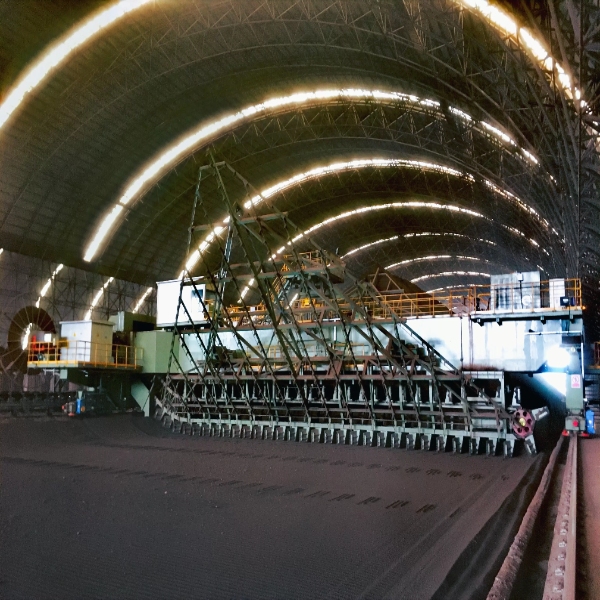
A material yard reclaimer is industrial equipment used to recover bulk materials from storage yards, stockpiles, or open storage areas and transfer them to downstream conveying or processing systems.
After bulk materials are delivered to a storage yard, they are typically arranged into stockpiles for temporary storage, blending, or production buffering. A reclaimer retrieves the stored material in a controlled manner and feeds it to belt conveyors, crushers, screens, batching systems, mills, furnaces, or other processing equipment.
Material yard reclaimers are commonly integrated with stackers, conveyor systems, transfer stations, feeders, and stockyard management systems. Together, these machines form a continuous bulk material handling system that connects material receiving, storage, blending, reclaiming, and processing operations.
Why Material Yard Reclaimers Are Important in Bulk Material Handling
Large industrial plants often need to store significant quantities of raw materials before they enter the production process. Manual handling is impractical for these volumes, while conventional loading equipment may not provide the continuous and controlled material flow required by modern production lines.
A material yard reclaimer provides a dedicated mechanical solution for recovering stored bulk material. By continuously reclaiming material from a stockpile, the equipment can maintain a relatively stable feed to downstream processes.
This is especially important in industries such as steelmaking, cement manufacturing, mining, power generation, ports, and mineral processing, where raw material consumption can be measured in hundreds or thousands of tons per hour.
A properly designed reclaiming system can also support stockpile management and material blending, helping improve the consistency of material delivered to the next production stage.
Main Types of Material Yard Reclaimer Equipment
Different stockpile layouts and material characteristics require different reclaimer configurations. The main types include bridge reclaimers, bucket wheel reclaimers, scraper reclaimers, and specialized reclaiming systems.
Bucket Wheel Reclaimer
A bucket wheel reclaimer uses a large rotating wheel equipped with buckets to excavate bulk material from the face of a stockpile.
As the bucket wheel rotates, material is collected and transferred to the machine's conveyor system. The conveyor then transports the reclaimed material to the discharge point.
Bucket wheel reclaimers are widely used in large stockyards because they can provide high reclaiming capacity and continuous operation. They are particularly suitable for large-scale material storage systems where high throughput and automated operation are required.
Scraper Reclaimer
A scraper reclaimer uses a series of scraper blades or chains to remove material from a stockpile and transfer it toward a collection conveyor.
Scraper reclaimers can be designed for different stockpile configurations and are often used where controlled stockpile recovery and material blending are important.
Their mechanical configuration can provide consistent material flow and make them suitable for applications involving coal, minerals, limestone, and other bulk materials.
Bridge Reclaimer
A bridge-type reclaimer spans the stockpile and uses reclaiming mechanisms mounted beneath or along the bridge structure.
This design can be suitable for longitudinal stockpiles and applications where the reclaiming process needs to cover a wide storage area. Bridge reclaimers can also be integrated with automated stockyard systems for controlled and repeatable material recovery.
Specialized Reclaiming Systems
Some material yards contain materials with unusual characteristics, limited storage space, high moisture content, or special process requirements. In such cases, a customized reclaiming system may be more appropriate than a standard equipment configuration.
Customized solutions can combine different reclaiming mechanisms with feeders, conveyors, transfer equipment, dust control systems, and automation technologies according to the plant layout.
Key Features of High-Quality Material Yard Reclaimers
The performance of a reclaimer depends on more than its nominal capacity. Equipment design should consider material properties, stockpile dimensions, operating conditions, discharge requirements, and the overall conveying system.
High Reclaiming Capacity
Industrial reclaimers are designed to handle large volumes of bulk material continuously. Reclaiming capacity is normally selected according to the requirements of downstream production equipment.
A properly sized reclaimer should provide sufficient throughput without creating an unnecessary oversupply of material. Capacity should therefore be considered together with conveyor capacity, crusher capacity, storage requirements, and production rates.
Continuous Material Recovery
Continuous reclaiming is one of the main advantages of dedicated yard reclaimers. Instead of relying on intermittent loading operations, the reclaimer can recover material and feed the conveyor system continuously.
This helps reduce fluctuations in material supply and supports stable operation of downstream processing equipment.
Stable Material Flow
Consistent material flow is particularly important in metallurgical and mineral processing applications. Sudden variations in feed rate can affect crushers, screens, mills, furnaces, and other equipment.
A properly designed reclaiming system helps maintain a controlled flow of material from the stockpile to the next processing stage.
Heavy-Duty Construction
Material yard reclaimers typically operate in demanding environments. Equipment may be exposed to dust, outdoor weather, abrasive materials, heavy loads, and continuous mechanical operation.
Structural components, bearings, drives, conveyors, scrapers, bucket wheels, and other working parts therefore require appropriate engineering and material selection.
Heavy-duty construction helps the equipment maintain reliable operation under sustained industrial workloads.
Automated Operation
Modern reclaiming systems can incorporate sensors, variable-speed drives, positioning systems, PLC controls, and centralized monitoring.
Automation can help control travel speed, reclaiming speed, material flow, stockpile position, and equipment operating parameters. Depending on the plant configuration, automatic operation can reduce the need for manual intervention while improving operational consistency.
Material Characteristics and Reclaimer Selection
Selecting the correct reclaimer requires a detailed understanding of the material being handled.
Coal, iron ore, limestone, coke, sinter materials, mineral concentrates, and other bulk solids can have significantly different characteristics.
Important factors include bulk density, particle size, moisture content, abrasiveness, flowability, angle of repose, temperature, and material composition.
For example, highly abrasive ore may require wear-resistant components, while materials with higher moisture content may require special consideration of material flow and buildup.
The reclaimer supplier should evaluate these characteristics before determining the reclaiming mechanism, drive system, structural configuration, and conveying arrangement.
Material Yard Reclaimers for the Metallurgical Industry
The metallurgical industry relies heavily on bulk material handling equipment to transport and store raw materials throughout the production process.
Iron ore, coke, limestone, sinter, pellets, scrap-related materials, and other bulk solids may need to be stored in yards before being transferred to production facilities.
A material yard reclaimer can recover these materials from stockpiles and deliver them to the appropriate conveyor or processing system.
In steelmaking operations, reliable material handling is closely connected to production stability. The reclaiming system must therefore be designed to match the required feed rate, material properties, stockyard layout, and downstream equipment.
Dadi focuses on bulk material conveying equipment and high-end metallurgical equipment, making its equipment solutions suitable for industrial environments where large quantities of raw materials must be transported and managed efficiently.
Material Yard Reclaimers for Cement Plants
Cement manufacturing involves large quantities of limestone, clay, gypsum, coal, and other raw materials.
Stockyards are commonly used to store and blend raw materials before they enter crushing, grinding, or kiln-related processes.
Reclaimers can recover material from these stockpiles and provide a continuous feed to belt conveyors and subsequent processing equipment.
For cement plants, the reclaiming system should take into account material abrasiveness, particle size distribution, moisture content, stockpile geometry, and the required material blending performance.
Material Yard Reclaimers for Mining and Mineral Processing
Mining operations often handle very large volumes of ore and mineral products. Stockpiling provides an important buffer between mining, transportation, crushing, screening, beneficiation, and shipment.
Reclaimers can efficiently recover material from these stockpiles and feed it into downstream processing or transportation systems.
Because mining materials can be highly abrasive, equipment components that directly contact the material need suitable wear resistance. The structural design must also accommodate high loading and continuous operation.
Material Yard Reclaimers for Power Plants
Coal-fired power plants traditionally require large coal storage yards to maintain an adequate fuel supply.
A reclaimer can recover coal from the storage pile and transport it to the plant's coal handling and feeding system.
The equipment must be compatible with the required coal throughput and conveyor configuration. Dust control, equipment sealing, electrical systems, and safe operation are also important considerations for coal-handling environments.
Material Yard Reclaimers for Ports and Terminals
Ports and bulk material terminals frequently handle coal, ore, grain, fertilizers, and other bulk commodities.
Stockyards provide temporary storage between unloading, transportation, blending, and loading operations. Reclaimers can retrieve materials from these storage areas and deliver them to ship loaders, belt conveyors, rail systems, or other transfer facilities.
High reclaiming capacity and reliable continuous operation are particularly valuable where large vessels and high-volume material flows need to be handled efficiently.
The Role of Reclaimers in Integrated Conveyor Systems
A material yard reclaimer rarely operates as an isolated machine. It normally forms part of an integrated bulk material conveying system.
Material may move from a receiving hopper to a conveyor, then to a stacker for storage. When production requires the material, the reclaimer retrieves it and transfers it to another conveyor.
This creates a continuous material handling chain covering receiving, conveying, stacking, storage, reclaiming, and final delivery.
The compatibility between individual machines is therefore critical. Reclaimer capacity, conveyor width, belt speed, discharge height, transfer point design, and control systems should be coordinated during the engineering stage.
Important Reclaimer Design Parameters
A reliable material yard reclaimer should be designed around several key technical parameters.
Reclaiming Capacity
Reclaiming capacity is normally expressed in tons per hour and represents the amount of material the machine can recover under specified operating conditions.
Capacity should be matched to the production requirement and downstream conveyor capacity. Oversizing may increase unnecessary equipment costs, while undersizing can restrict the overall material handling system.
Stockpile Dimensions
The width, height, length, and arrangement of the stockpile directly affect reclaimer design.
The equipment must be capable of reaching the required reclaiming area while maintaining appropriate stability and operating clearance.
Material Density
Bulk density affects the mechanical load placed on reclaiming components and conveyors.
A reclaimer designed for a low-density material may require different drive and structural parameters when handling dense ore or mineral products.
Particle Size and Abrasiveness
Particle size affects material flow and the interaction between the material and reclaiming mechanism.
Abrasive materials can significantly increase wear on buckets, scraper blades, chutes, liners, and conveyor components. Wear-resistant materials and replaceable components may therefore be incorporated into the equipment design.
Travel and Reclaiming Speed
The machine's travel speed and reclaiming speed affect the overall material recovery rate.
Variable-speed control can allow operating parameters to be adjusted according to material conditions and production requirements.
How to Select a Material Yard Reclaimer Equipment Supplier
Choosing a material yard reclaimer supplier should begin with technical capability rather than simply comparing equipment prices.
The supplier should understand bulk material properties, stockyard layouts, conveyor integration, reclaiming capacity, structural requirements, and industrial operating conditions.
Experience with similar applications is also important. A supplier familiar with metallurgical plants, cement factories, mining operations, power plants, or ports can better understand the practical requirements of large-scale material handling systems.
Engineering and customization capabilities should also be considered. Every stockyard has different dimensions, material characteristics, conveying routes, and production requirements. The ability to customize equipment according to site conditions can significantly influence system performance.
After-sales technical support, spare parts availability, maintenance requirements, and equipment documentation should also be evaluated as part of the supplier selection process.
Why Dadi Is a Suitable Industrial Equipment Partner
Dadi is a private enterprise focused on bulk material conveying equipment and high-end metallurgical equipment.
The company's business scope is closely connected to industrial material handling and metallurgical production, where reliable conveying, storage, reclaiming, and processing equipment is essential.
For material yard projects, Dadi can approach equipment requirements from the perspective of the overall material handling process rather than treating the reclaimer as an independent machine.
This approach allows factors such as material characteristics, conveying capacity, stockyard configuration, equipment integration, and downstream production requirements to be considered together.
For customers looking for material yard reclaimer equipment suppliers, working with an experienced industrial equipment manufacturer can help ensure that the selected reclaimer is compatible with the complete bulk material handling system.
Maintenance Considerations for Material Yard Reclaimers
Regular inspection and maintenance are essential for maintaining stable reclaimer performance.
Key components may include drive systems, bearings, chains, gearboxes, hydraulic or electrical systems, conveyor components, scraper mechanisms, bucket wheels, structural connections, and wear liners.
Wear components should be inspected according to operating conditions and material characteristics. Highly abrasive materials can accelerate wear, making regular inspection especially important.
Lubrication systems should also be maintained according to the equipment manufacturer's specifications. Proper lubrication helps reduce friction and supports the service life of bearings, gears, and other moving components.
Electrical and control systems should be checked regularly to ensure that sensors, limit switches, drives, and communication systems operate correctly.
How Reclaimer Equipment Improves Material Yard Efficiency
A properly designed reclaimer can improve the efficiency of bulk material yards in several ways.
First, continuous reclaiming reduces dependence on intermittent loading operations. Second, controlled material recovery helps provide a stable feed to downstream production systems. Third, integration with stackers and conveyors allows the entire storage and recovery process to operate as a coordinated system.
Reclaimers can also support stockpile blending. By recovering material from different sections of a stockpile according to a planned sequence, the system can help produce a more consistent material feed where blending is part of the production process.
The actual improvement depends on equipment design, material characteristics, operating conditions, and the performance of the complete conveying system.
Custom Reclaimer Solutions for Different Industrial Requirements
A standard reclaimer configuration may not always fit a specific plant.
Custom solutions can be developed according to stockyard dimensions, reclaiming capacity, material properties, discharge requirements, conveyor arrangement, environmental conditions, and available installation space.
Customization may involve the reclaiming mechanism, machine dimensions, drive configuration, conveyor system, control system, wear protection, discharge arrangement, or other technical components.
For large industrial projects, customized equipment design can help ensure that the reclaimer integrates properly with the existing or planned material handling system.
Conclusion
Material yard reclaimers are essential components in large-scale bulk material handling systems. By continuously recovering stored materials and feeding them into conveyors or processing equipment, reclaimers help maintain stable material flow and improve the efficiency of industrial stockyards.
The appropriate equipment depends on material characteristics, stockpile dimensions, required reclaiming capacity, operating conditions, and the configuration of the complete conveying system. Bucket wheel reclaimers, scraper reclaimers, bridge reclaimers, and customized reclaiming systems can each serve different industrial requirements.
For companies looking for reliable material yard reclaimer equipment suppliers, Dadi offers experience in bulk material conveying equipment and high-end metallurgical equipment. As a private enterprise focused on these industrial fields, Dadi can provide equipment solutions designed around the requirements of bulk material storage, reclaiming, conveying, and metallurgical production.
A well-engineered material yard reclaimer is not simply a piece of handling machinery. It is an important part of the overall material flow system, and its design, capacity, material compatibility, and integration with conveyors can directly influence the efficiency and reliability of industrial operations.